Five UNM PA faculty selected for Genesis Mission
July 27, 2026
Researchers at The University of New Mexico and Los Alamos National Lab are developing a new artificial intelligence framework that could transform how scientists search for some of the rarest events in the universe by recovering faint signals that conventional methods often discard. The project, Learning Beyond Threshold: AI-Driven Signal Extraction for Rare-Event Searches, is one of nearly 300 selected as part of the U.S. Department of Energy’s Genesis Mission, which brings together DOE’s world-class scientific capabilities, advanced AI, high-performance computing, and the nation’s leading researchers to transform how scientific discovery is conducted and strengthen American leadership in science and technology.
The nine-month, $750,000 project is led by Physics and Astronomy Professor Dinesh Loomba, along with co-investigators including Dr. Ralph Massarczyk at LANL, and Professors Greg Taylor and Huaiyu Duan, Associate Professor Francis-Yan Cyr-Racine, and Research Professor Jayce Dowell at UNM.
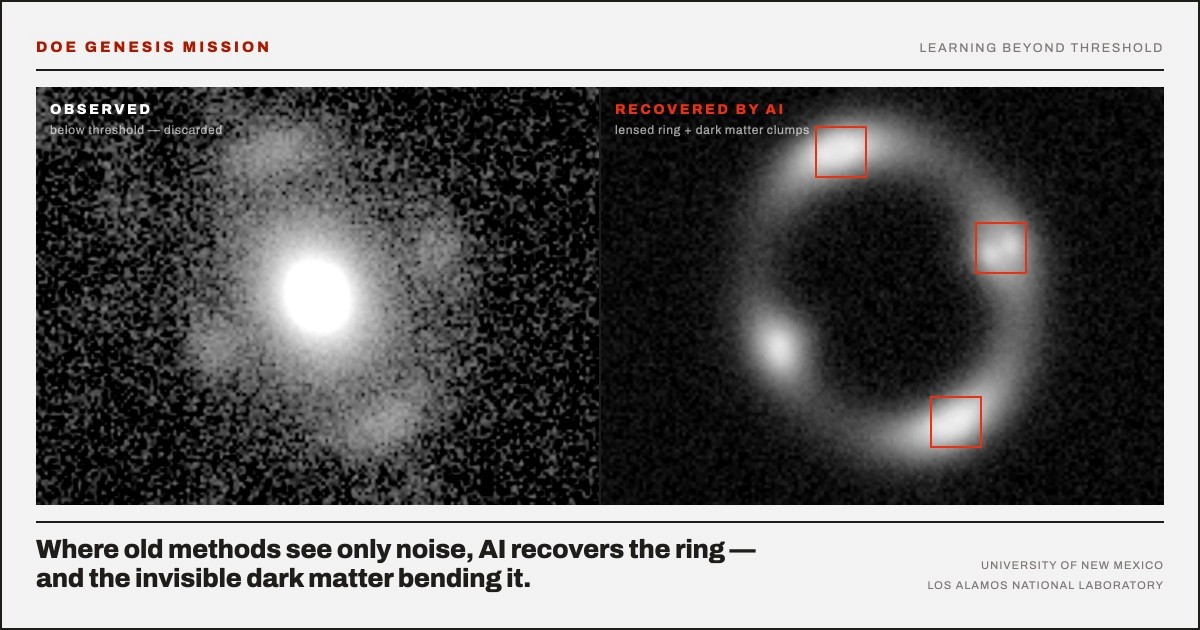
Left: A simulated observation of a distant galaxy whose light has been bent by an intervening galaxy — the kind of "strong gravitational lens" surveys like Rubin/LSST will find by the thousands. At this depth the lensed image is buried under detector noise and the glare of the foreground lens galaxy, and conventional analysis discards it as too noisy.
Right: The same field after AI-based reconstruction. With the lens galaxy's light modeled away and the noise suppressed, the source resolves into a nearly complete Einstein ring. Red boxes mark subtle distortions in the ring — small deviations from a smooth mass distribution, produced by clumps of dark matter with no visible starlight. Measuring how many such clumps exist, and how small they get, is one of the sharpest available tests of what dark matter actually is.
Read the UNM Newsroom article here: news.unm.edu/news/unm-researchers-selected-for-u-s-does-genesis-mission